

Excursions
Full day excursions - lunch included
Departure at 08:00
- Cost: € 80 per person (Guided tour, private bus, visit and lunch)
- Please, book the full day excursion when registering, the soonest to ensure your booking and waits for the reconfirmation
Please be prepared with comfortable and appropriate footwear and clothing for the all-day hike.
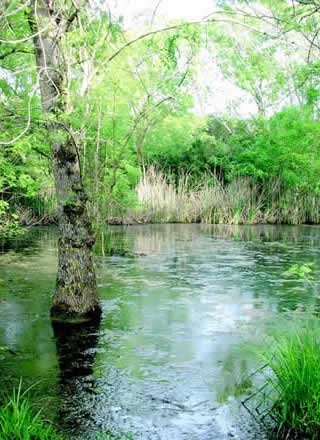
A coastal treasure in rome: the wood of Palo laziale
(Oasi di Palo laziale – Ladispoli, Rome)
Just at one-hour distance ore from Rome's vibrant cafes and historic colonnades lies a wild and wonderful land. The Natura 2000 site, ‘Bosco di Palo Laziale' preserves one of the last remnants of an ancient coastal floodplain forest that once spanned central Italy's coastline. This area hosts important priority habitats, such as Mediterranean temporary ponds, and provides refuge for numerous protected species, including the European pond turtle (Emys orbicularis) and Hermann's tortoise (Testudo hermanni).
As part of the LIFE PRIMED project ("Restoration, management and valorisation of PRIority habitats of MEDiterranean coastal areas"), several ecological restoration measures have been implemented in Bosco di Palo Laziale, including ex-situ in-situ plant conservation activities for keystone species of target habitats. Conference attendees will have the chance to visit this special site
WHAT TO BRING
Visitors planning to explore Palo Laziale should bring a waterproof rain jacket and sturdy walking or trekking shoes. We will spend the entire morning and afternoon outdoors on the third day, participating in excursions and field activities. Please be prepared for the weather and outdoor conditions. In late September, the average minimum temperature in Palo Laziale is around 15°C, and the average maximum temperature is around 25°C.
For info: https://www.lifeprimed.eu/en/about-the-project/sites-descriptions/palo-laziale
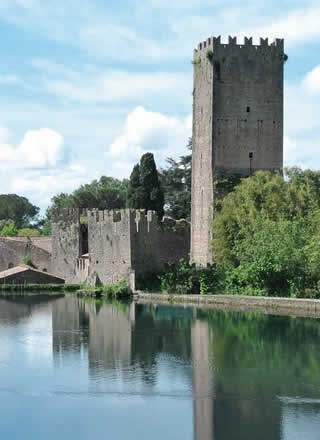
The Garden of Ninfa
(Cisterna di Latina, Latina)
The name Ninfa derives from a Roman temple built near the current garden and dedicated to the deities of spring waters.
Ninfa was part of a larger territory called Campagna and Marittima. In the 8th century it became part of the papal administration and had a strategic role due to the presence of the pedemontana road that allowed people to go south avoiding the often swampy Appian Way.
From the 11th century Ninfa took on the role of a city and was governed by various noble families such as the Tuscolo, the Frangipane, under whom the city's architecture flourished and the economic and political importance of Ninfa grew: in 1159 Cardinal Rolando Bandinelli was crowned Pope Alexander III in the church of Santa Maria Maggiore, the ruins of which are still visible today. And then the Conti, the Colonna family and finally the Caetani.
In 1298 Benedetto Caetani, known as Pope Boniface VIII, purchased Ninfa and other neighboring territories for his nephew Pietro II Caetani, marking the beginning of the presence of the Caetani in the Pontine and Lepine territory.
From the 14th to today
In 1382 Ninfa was sacked and destroyed by troops supporting the antipope in the Great Schism. The city was never rebuilt.
At the end of the 19th century, the Caetanis returned to their long-abandoned properties. Ada Bootle Wilbraham, an Englishwoman and wife of Onoraro Caetani, with two of her six children, Gelasio and Roffredo, took care of Ninfa, creating a garden in Anglo-Saxon style. They reclaimed the marshes, uprooted much of the weeds that covered the ruins, planted the first cypresses, holm oaks, beech trees, now majestic, and a large number of roses, and restored some ruins, including the baronial palace (town hall), which became the family's country house, today home to some offices of the Roffredo Caetani Foundation. The creation of the garden was guided above all by sensitivity and feeling, following a free, spontaneous, informal direction, without an established geometry.
Marguerite Chapin, wife of Roffredo Caetani, introduced new species of shrubs and roses, but above all, in the 1930s, she opened the doors of the garden to the circle of writers and artists linked to the literary magazines she founded, “Commerce” and “Botteghe Oscure”.
The last heir and gardener was Lelia, daughter of Roffredo Caetani. A sensitive and delicate woman, she looked after the garden like a large painting, being a painter, combining colors and supporting the natural development of the plants, without forcing, and avoiding the use of polluting substances. Together with her mother Marguerite, she introduced numerous magnolias, prunus, climbing roses, and created the rock garden, also called “colletto”. Donna Lelia established the Roffredo Caetani Foundation in 1972, five years before her death, in order to protect the memory of the Caetani family, and to preserve the garden of Ninfa and the castle of Sermoneta.
For info: https://www.giardinodininfa.eu/
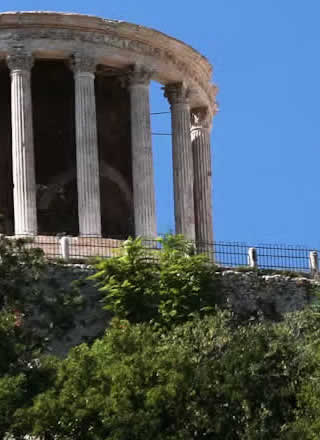
Villa Gregoriana
(Tivoli, Rome)
Loaned to FAI by the Italian State in 2002. In the city of Tivoli, only half an hour from Rome, Parco Villa Gregoriana preserves a rich heritage, resonating with the sublime imagery that was so popular in the Romantic period. Nature, history, archaeology and craft merge in such an enthralling blend that in the 19th century this site became a must-see destination of the Grand Tour and the most popular subject in the paintings portraying Tivoli. In 1832, on the initiative of Pope Gregory XVI, an impressive work of hydraulic engineering was undertaken to contain the unceasing floods of river Aniene. The stream was deviated in a double tunnel dug into Mount Catillo: the water, channeled in this bottleneck, increased its level and fell in the artificial 120 meters waterfall known as Cascata Grande, which is today the second highest waterfall in Italy, behind Marmore Falls. In addition to that, the Pope created the Park that bears his name and was, for over a century, a favoured destination for artists, writers and men of culture, who disclosed its beauty to the whole world. After World War II, Parco Villa Gregoriana became the property of the State and in 2002 it was loaned to FAI. At that time, the site was in an advanced state of abandonment and hydrogeological instability.
FAI’s commitment, however, brought it back to life: in 2005, Parco Villa Gregoriana reopened to visitors, who today can immerse themselves in the most luxuriant greenery, walk through the old trails finally free from brambles, smell the scents previously buried under decades of neglect and abandonment, use all the senses to discover the 74 tree species found in the park, explore interesting relics of past eras. Among these, the highlights are the remains of the Villa of the Roman Consul Manlius Vopiscus, a sumptuous residence celebrated by Horace, and the Roman temples on the acropolis, which include the renowned Temple of Vesta.
For info: https://fondoambiente.it/parco-villa-gregoriana-eng/